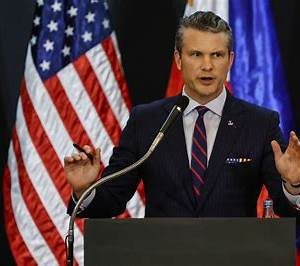
The Pentagon issues statements. Pete Hegseth issues stories. In the modern media ecosystem, that difference matters. Official language is careful, conditional, and slow. Hegseth’s commentary is direct, moralized, and immediate. For audiences navigating uncertainty about military power and national security, the latter often feels more real. This is how a television voice can begin to outweigh institutional communication.
Hegseth’s strength lies in narrative compression. He reduces sprawling policy debates into clear binaries: strength versus weakness, readiness versus decay, leadership versus drift. Media analysts note that such framing thrives in environments of distrust, where audiences are skeptical of official assurances. By presenting himself as a translator of military reality—someone who “says what institutions won’t”—Hegseth positions his voice as a corrective to perceived obfuscation. The effect is cumulative: each appearance reinforces the idea that truth lives outside the institution.
This dynamic exposes a vulnerability in institutional communication. The Pentagon speaks to avoid error; Hegseth speaks to command attention. One is bound by process, the other by performance. In a fragmented media landscape, performance often wins. Hegseth’s commentary moves faster than policy explanations, shaping perception before official narratives can stabilize. By the time institutions respond, the story may already be set.
Digital amplification accelerates this imbalance. Hegseth’s remarks circulate as clips optimized for speed and impact. These fragments are shared, debated, and reused as evidence within broader arguments. Over time, audiences encounter his framing more frequently than official statements. Media researchers emphasize that frequency creates familiarity, and familiarity creates trust. This is not a judgment on accuracy; it is a description of how authority is built in the digital age.
Institutional conflict sharpens the contrast. When military leadership is questioned or policy decisions spark backlash, Hegseth’s voice fills the interpretive gap. He provides a story that feels decisive, even when reality is not. Journalism scholars warn that such clarity can oversimplify, but they also acknowledge its power. In moments of uncertainty, audiences gravitate toward voices that appear confident and consistent. Hegseth offers both.
Public perception follows suit. To supporters, Hegseth sounds like truth unfiltered by bureaucracy. To critics, he represents the politicization of military discourse. Yet both camps amplify him—sharing clips, responding to arguments, keeping his framing alive. In the attention economy, reaction sustains relevance. Hegseth’s authority grows not despite controversy, but because of it.
Career evolution explains how he sustains this position. Leaving behind institutional roles freed him from procedural restraint, allowing him to focus entirely on narrative. He does not need to reconcile competing priorities or manage consequences. He needs to be present, clear, and repeatable. Media historians note that this is the defining advantage of commentary over governance: freedom from accountability in exchange for influence.
Why does Pete Hegseth’s voice sometimes feel heavier than the Pentagon’s? Because it moves where institutions cannot—fast, moralized, and everywhere. In a media environment that rewards certainty over caution, his stories travel farther than official statements ever could. And in modern politics, the story often becomes the reality.