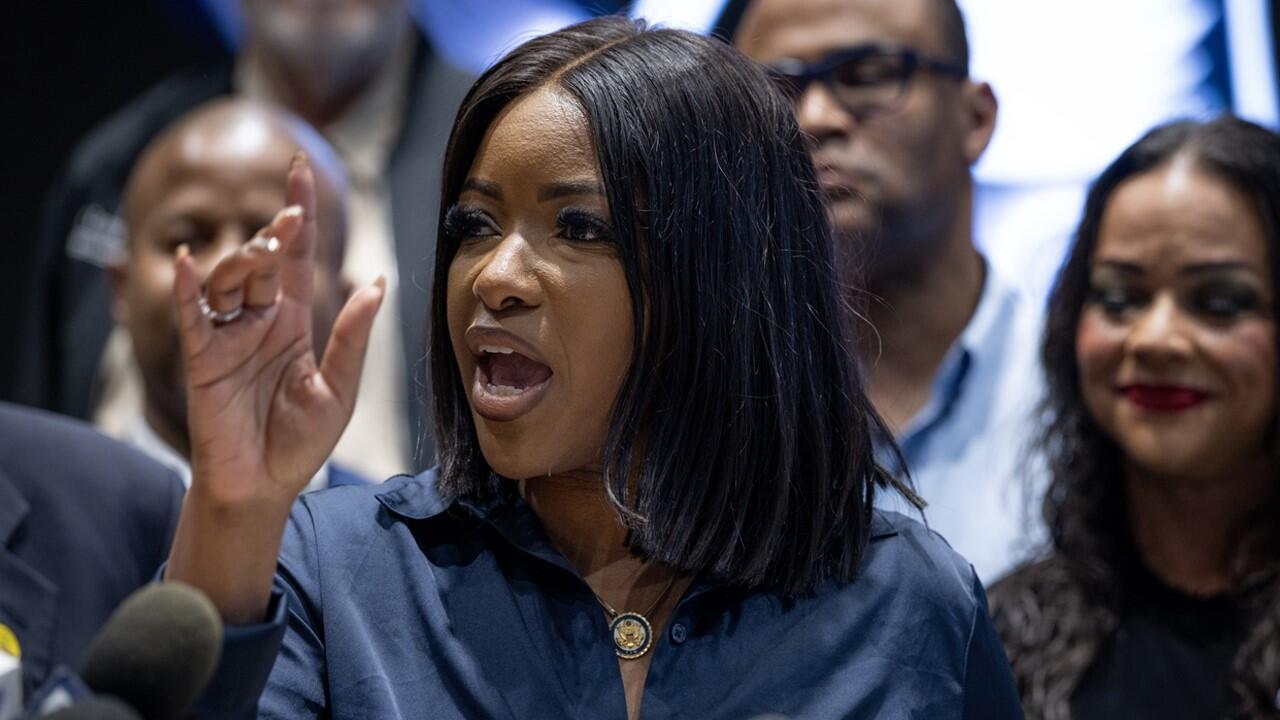
A new political firestorm erupted this week after Rep. Jasmine Crockett of Texas delivered pointed remarks questioning the way deportation, immigration, and public-safety priorities are framed in the United States. What began as a routine policy exchange quickly escalated into a national debate, exposing once again how sharply Americans disagree about the threats facing the country — and who is responsible for them.
The controversy unfolded during a public forum in Texas, where Crockett challenged what she described as “a one-sided conversation” about crime and security. In her view, political leaders disproportionately focus on migrants and border-related offenses while downplaying — or outright ignoring — the risks posed by domestic extremist groups. And it was a single line from her remarks that set the debate ablaze:
“We cannot pretend our greatest dangers are only coming from the outside when so many of them are growing from within.”
Crockett’s Case: Domestic Extremism Deserves Equal — If Not Greater — Attention
Crockett pointed to acts of violence tied to white supremacist and other extremist movements inside the U.S., arguing that these groups represent a persistent and significant threat that receives far less political oxygen than immigration narratives.
She also referenced a body of research that has become increasingly visible in policy discussions: studies showing that, overall, immigrants are statistically less likely to commit violent crimes than native-born citizens. Although she did not cite a specific study onstage, the data she invoked mirrors conclusions often highlighted by criminologists, think tanks, and non-partisan research groups.
“Public safety should not be reduced to one talking point,” Crockett said. “If we’re serious, then we have to be clear-eyed. We have extremists in this country who are recruiting, plotting, and acting with deadly intent. They’re not crossing the border — they’re already here.”
To her supporters, it was a long-overdue challenge to a political narrative they see as incomplete at best and intentionally misleading at worst. To her critics, it was a reckless dismissal of legitimate security concerns at the southern border.
Immediate Conservative Backlash
Crockett’s comments drew swift criticism from conservative lawmakers, commentators, and immigration-focused advocacy groups. Many argued she had downplayed the seriousness of unlawful entry, drug trafficking, and foreign-based extremist networks that, in their view, form the core justification for U.S. deportation policy.
Rep. Aaron Mendoza of Arizona called Crockett’s comments “astonishingly irresponsible,” saying that border states are facing “a humanitarian surge and real dangers from cartel-linked operations.”
Others accused her of attempting to shift blame away from criminal acts committed by undocumented migrants, citing high-profile incidents that have dominated conservative media coverage.

“Deportation exists for a reason,” one conservative analyst wrote on social media. “This isn’t theoretical — there are security risks tied to illegal entry. Crockett is acting like acknowledging that is somehow extremist.”
The framing resonated with many voters, particularly those who see border security as a top political priority heading into the next election cycle.
Supporters: “She’s Telling the Truth Politicians Avoid”
Crockett’s supporters, however, say her remarks captured a deeper frustration among Americans who believe public-safety debates are often shaped more by political convenience than actual data.
Civil rights groups and anti-extremism researchers rushed to defend her, arguing that dismissing domestic radicalization — especially white supremacist-linked violence — leaves communities vulnerable.
“Calling attention to homegrown extremism is not minimizing border security,” said one Texas activist. “It’s asking our leaders to confront all threats, not only the ones that fit neatly into a campaign slogan.”
Crockett’s allies pointed out that federal agencies, including the FBI, have repeatedly warned of the dangers posed by domestic extremist groups. These groups, they say, have carried out some of the most lethal attacks in the U.S. over the past decade.
To them, Crockett’s comments reflected a broader demand: that public-safety conversations acknowledge inconvenient truths, not just politically comfortable ones.
A Debate Exposing America’s Deepest Divides
The intensity of the reaction to Crockett’s remarks reflects how polarized the country has become over questions of identity, security, and national priorities.
At the heart of the divide lies a fundamental disagreement:
Should public-safety discussions in the United States focus more on threats from abroad — or threats from within?

For some, the border is the frontline of national security, and any attempt to shift attention elsewhere feels like an evasion.
For others, domestic extremist movements pose a more consistent and immediate danger — one that has been politically neglected for far too long.
Neither side appears interested in yielding ground.
Election-Year Pressure Amplifies Everything
With immigration and extremism ranking among the top issues for voters, every statement by a national figure is amplified through an election-year lens.
Political strategists on both sides said Crockett’s remarks are likely to become campaign talking points — either as evidence of Democrats being “soft on border security,” or as proof of their willingness to confront uncomfortable realities about domestic radicalization.
Social media only poured fuel on the fire. Within hours, hashtags supporting and condemning Crockett were trending simultaneously, creating what one analyst described as a “perfect simulation of America today — furious, fragmented, and shouting past each other.”
An Argument That Isn’t Going Away

If Crockett intended to force a broader conversation about public safety, she succeeded. But the price of that success is a debate that is likely to grow even louder, sharper, and more politically charged.
As the United States continues wrestling with questions of identity, safety, and responsibility, her remarks have become a flashpoint — not because they created new tensions, but because they exposed ones that were already there.
And as the election approaches, one reality is undeniable:
America isn’t just arguing about threats.
It’s arguing about which threats it’s willing to see.